

- cross-posted to:
- technology@lemmy.world
- hardware@lemmy.world
- cross-posted to:
- technology@lemmy.world
- hardware@lemmy.world
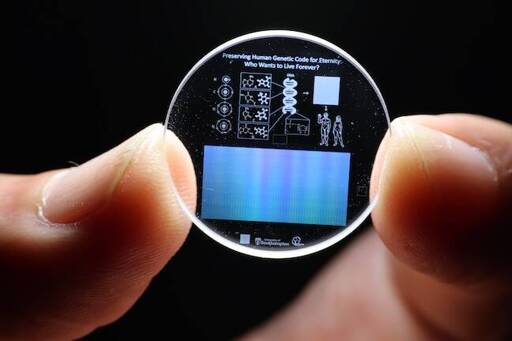
After decades of research and development, humanity finally has a data storage medium that will outlast us.
The 5D Memory Crystal stores data by using tiny voxels – 3D pixels – in fused silica glass, etched by femtosecond laser pulses. These voxels possess “birefringence,” meaning that their light refraction characteristics vary depending upon the polarization and direction of incoming light.
That difference in light orientation and strength can be read in conjunction with the voxel’s location (x, y, z coordinates), allowing data to be encoded in five dimensional space.
And because the medium is silica crystal, similar to optical cable, it’s highly durable. It’s also capacious: The technology can store up to 360 TB of data on a 5-inch glass platter.
A technology I’ve been eagerly anticipating for many, many years now. It still sounds like it’s in the “Real Soon Now, honest!” Phase though:
[…]
[,]
Which is where it’s been for all of those many years I’ve been anticipating it. But who knows, perhaps this will be the company to finally start selling them. I’m fine with them being expensive at first, the cost will come down if they take off.
That’s not bad at all. It’s something that basically every library could have. Imagine that level of distributed redundancy for hundreds of terrabytes worth of information, in a medium that essentially lasts forever.
Assuming it really is coming out at that price of course.