Tube trains of the future may soon know exactly where they are underground -- even in places where GPS is blind -- by tapping into the strange rules of the quantum world.
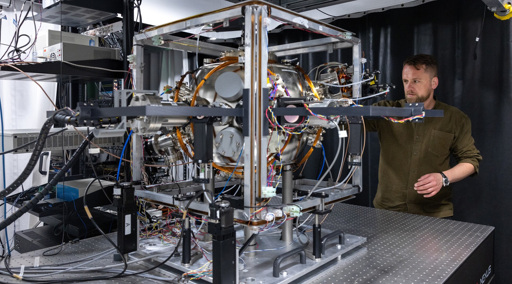
Instead of relying on conventional sensors, these devices use clouds of atoms cooled to near absolute zero. At those temperatures, atoms start to behave strangely — acting as both particles and waves. As the atoms “fall” through a sensor, their wave patterns shift in response to acceleration. Using what’s effectively an ultra-precise optical ruler, the system can read these changes with extraordinary accuracy, without needing satellites at all.
Is it really too much to place a 50p zigbee proximity sensor, at 100m intervals along a line, and mesh them together?
The totality of tube line sprawl is near 400km[0]. Quick math:


Is it really too much to place a 50p zigbee proximity sensor, at 100m intervals along a line, and mesh them together?
The totality of tube line sprawl is near 400km[0]. Quick math:
There, I just saved the goverment a million quid
0: https://en.wikipedia.org/wiki/London_Underground_infrastructure#Lines
Or just put a standard accelerometer on a train and recalibrate automatically at each station. Wtf is this quantum mechanic use case