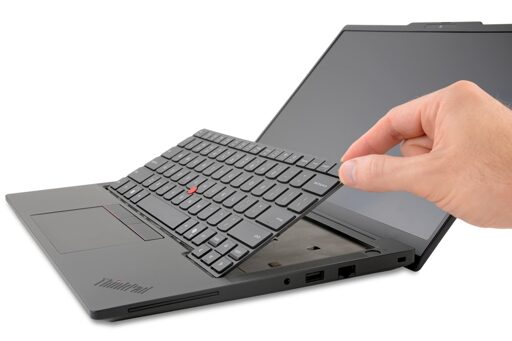
Repair goes mega mainstream with the launch of Lenovo’s new T-series business laptops, which earned our highest honor with a 10/10 repairability score.
So, some of rakabis’ advice is pretty good. I’ll just say that if you’re wanting to get away from being locked into a computational ecosystem with an even worse support lifetime than windows devices, avoid buying a Mac. A 2018 MacBook stopped receiving 90% of updates in 2024.
Caveat that by saying that older MacBooks, i.e. pre Mac made chips, are usually pretty reasonably priced on the used market. If you’re willing to switch to Linux then there’s even really good support for the hardware, with basically every distro working on MacBooks with Intel chips out of the box. The only part of deploying Linux on my wife’s 2017 MB Air that was REALLY a headache was the webcam. There’s info on every step to get the drivers installed and everything working, it’s just not all in one place, and a little outdated.
If you have the money and want simplicity, reliability, and interoperability, go for a Mac. Just clench your sphincter and maximize the RAM; min. 32Gb ought to be minimally appropriate for a 7-8yr lifespan of basic duties. And FFS, go for what your current data uses up ×2.5 or 1Tb, whichever is larger (vital performance reasons in that). Don’t get the smallest storage unless third-party upgrade options exist like for the Mac Mini M4. And remember: all RAM and a lot of storage is integrated these days, which is why you should always max it out; there is no upgrade path except wholesale replacement of the machine. CPU is largely immaterial unless you are doing truly heavy lifting like video editing or AI, so that can often be the lowest choice.
If you want freedom and truly unconstrained system, some form of Linux/BSD on a Framework system is the way to go. Or if a desktop, hand-assemble it yourself.
If you are going to stick with Windows, go for a business-class Dell. Trust me, it’ll be almost as $$$$ painful as a Mac, but these little f**kers are built to last. At least you can upgrade the RAM and on-board storage, although I honestly recommend not going under 32Gb for anything other than basic tasks. It’ll be a lot more zippy with 32Gb even if you spend the first week tearing all the AI and built-in spyware out of Windows.


How would you recommend someone shop for a laptop? Any good guides?
So, some of rakabis’ advice is pretty good. I’ll just say that if you’re wanting to get away from being locked into a computational ecosystem with an even worse support lifetime than windows devices, avoid buying a Mac. A 2018 MacBook stopped receiving 90% of updates in 2024.
Caveat that by saying that older MacBooks, i.e. pre Mac made chips, are usually pretty reasonably priced on the used market. If you’re willing to switch to Linux then there’s even really good support for the hardware, with basically every distro working on MacBooks with Intel chips out of the box. The only part of deploying Linux on my wife’s 2017 MB Air that was REALLY a headache was the webcam. There’s info on every step to get the drivers installed and everything working, it’s just not all in one place, and a little outdated.
If you have the money and want simplicity, reliability, and interoperability, go for a Mac. Just clench your sphincter and maximize the RAM; min. 32Gb ought to be minimally appropriate for a 7-8yr lifespan of basic duties. And FFS, go for what your current data uses up ×2.5 or 1Tb, whichever is larger (vital performance reasons in that). Don’t get the smallest storage unless third-party upgrade options exist like for the Mac Mini M4. And remember: all RAM and a lot of storage is integrated these days, which is why you should always max it out; there is no upgrade path except wholesale replacement of the machine. CPU is largely immaterial unless you are doing truly heavy lifting like video editing or AI, so that can often be the lowest choice.
If you want freedom and truly unconstrained system, some form of Linux/BSD on a Framework system is the way to go. Or if a desktop, hand-assemble it yourself.
If you are going to stick with Windows, go for a business-class Dell. Trust me, it’ll be almost as $$$$ painful as a Mac, but these little f**kers are built to last. At least you can upgrade the RAM and on-board storage, although I honestly recommend not going under 32Gb for anything other than basic tasks. It’ll be a lot more zippy with 32Gb even if you spend the first week tearing all the AI and built-in spyware out of Windows.
Running a business class Dell on Debian. Fantastic machine.