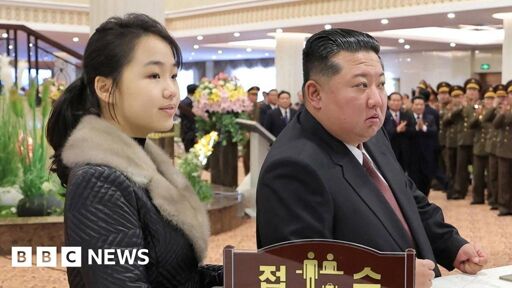

North Korean leader Kim Jong Un has selected his daughter as his heir, South Korea’s spy agency told lawmakers on Thursday.

Kim Ju Ae - who is believed to be 13 - has in recent months been pictured beside her father in high-profile events like a visit to Beijing in September, her first known trip abroad.

The National Intelligence Service (NIS) said it took a “range of circumstances” into account including her increasingly prominent public presence at official events" in making this assessment.

  • Riverside@reddthat.com
    link
    fedilink
    English
    arrow-up
    1
    arrow-down
    1
    ·
    edit-2
    13 hours ago

    About Saudi Arabia:

    The kafala system or kefala system (Arabic: نظام الكفالة niẓām al-kafāla, lit. ‘sponsorship system’) is a system in the Middle East that involves binding the residency and employment status of a migrant worker to a specific employer throughout the period of their residence in a country. Under this arrangement, the employer holds substantial authority over the worker, including the ability to approve or deny job changes, and permission to leave the country. This dependency creates a significant power imbalance that heightens the risk of exploitation and abusive practices.

    Demographics in Saudi Arabia:

    However, 38.3% of the residents (or about 13.3 million people) are non-citizens,[8] and many of them are migrant workers.

    When 40%ish of the population is without basic human rights, idk what you’re claiming false about my arguments

    Regarding sources for North Korea, the YouTube channel “DPRK Explained” does a great job of showing the realities of North Korea. You should have a look if you’re interested.

    • psx_crab@lemmy.zip
      link
      fedilink
      English
      arrow-up
      2
      ·
      11 hours ago

      You:

      For example, Saudi Arabia, a widely known example of a monarchy with absolutist power, has 80% of the population composed of immigrants without rights who get stripped of their passports and get treated as slaves.

      Also you:

      When 40%ish of the population is without basic human rights

      Wanna try again?

      Then you:

      There’s no public healthcare

      https://en.wikipedia.org/wiki/Health_care_in_Saudi_Arabia

      Health care in Saudi Arabia is a national health care system in which the government provides free universal healthcare coverage through a number of government agencies.

      Then you also:

      no infrastructure for poor people (trains, public schools, people-centered urbanism…), etc.

      https://en.wikipedia.org/wiki/Education_in_Saudi_Arabia

      Public education in Saudi Arabia—from primary education through college—is open to every Saudi citizen. Education is the second-largest sector of government spending in Saudi Arabia.[7] Saudi Arabia spends 8.8% of its gross domestic product on education, which is nearly double the global average of 4.6%.

      https://en.wikipedia.org/wiki/Al_Mashaaer_Al_Mugaddassah_Metro_line

      https://en.wikipedia.org/wiki/Riyadh_Metro

      There are several other line being planned.

      • Riverside@reddthat.com
        link
        fedilink
        English
        arrow-up
        1
        ·
        5 hours ago

        The 80% figure I mistook for the one of Qatar originally, which has a similar system but 88% of their population are immigrants without rights.

        Every service you pointed out leaves immigrants without access, 40% of Saudi population not having access to healthcare is exactly my point. Wikipedia explicitly says this healthcare is for citizens, and when 40% are non citizens, it’s a de-facto apartheid state with half the population being immensely exploited

        Why are you running defense for authoritarian monarchies in the Middle East?

    • lad@programming.dev
      link
      fedilink
      English
      arrow-up
      2
      ·
      12 hours ago

      I thought it was 80% migrants? Also, except for the bit about permission to leave country (crazy, imo) that sounds like a normal work permit in many conventionally democratic countries, where employer also uses it’s power over migrant workers. It might be worse in practice, of course, that depends on courts

      • Riverside@reddthat.com
        link
        fedilink
        English
        arrow-up
        1
        ·
        5 hours ago

        Sorry, mistook it originally for the Qatar figure, which has a similar system and 88% migrant population.

        Also, except for the bit about permission to leave country (crazy, imo) that sounds like a normal work permit in many conventionally democratic countries, where employer also uses it’s power over migrant workers

        When immigrant workers aren’t given access to basic rights like healthcare, it’s an apartheid state. You could read about it instead of speculating about the extreme levels of exploitation of those poor people.

        • lad@programming.dev
          link
          fedilink
          English
          arrow-up
          1
          ·
          5 hours ago

          My point was more along the lines of specific democracies doing almost as bad, and being a counterexample for extracting political system information from unrelated data