- cross-posted to:
- piracy@lemmy.ml
- datahoarder@lemmy.ml
- piracy@lemmy.dbzer0.com
- cross-posted to:
- piracy@lemmy.ml
- datahoarder@lemmy.ml
- piracy@lemmy.dbzer0.com
You must log in or # to comment.
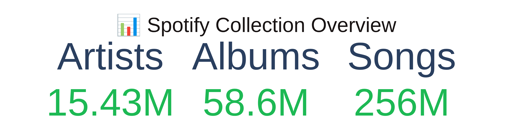
This is by far the largest music metadata database that is publicly available. For comparison, we have 256 million tracks, while others have 50-150 million. Our data is well-annotated: MusicBrainz has 5 million unique ISRCs, while our database has 186 million.
Does this mean the MusicBrainz database will soon go from 5 million to 186 million tracks?
Asking the real questions here…
Probably not worth it to store the AI tracks
That’s exactly what I was wondering too.
Acquiring high quality music is already easy enough in most cases.
What I am interested in is the metadata. Accurate tagging of all my files is of high interest.
If I ran mb, I would be cautious importing the data directly. I’m sure Spotify would consider it trade information and go after anyone directly using it. However if a few million people added the tracks with individual edits then it probably won’t take too long.
I thought metadata couldn’t be copyrighted though?
It can’t, but I’m sure that wouldn’t stop Spotify from raising a stink if they see it being bulk imported. I’d imagine this would be similar to OpenStreetMaps and Google Maps; they probably could scrape and bulk import missing info, but they restrict it to licensed sources and user edits to limit liability and enforce quality.
In cartography the expression of the uncopyrightable data is itself copyrighted (e.g. colors used, thickness of ligns) so maybe certain data fields are owned by Spotify (e.g. genre, description, history, song notes)
ligns
that’s a fascinating typo.
You know, I thought it didn’t look right, but I typed it into Google and it didn’t autocorrect so I went with it.
Rhymes with signs, it must be right.
I’ll strongly suggest to take out all the cheaply AI generated music from this “back up” and save themselves some space.
I’m not sure how they would go about doing that at scale without also getting some false positives and removing human music too
You could cut off your search around the time AI tracks started to appear. Not sure when that was, maybe 2023. You’d miss a lot of recent stuff, but you’d filter out a lot of spam too
I see your point, but as you say, there would still be the tradeoff of missing more recent stuff. That might only involve missing a couple of years’ worth of stuff now, but AI isn’t going away any time soon, so it would mean that there’d be an increasing amount of human made music not being archived; One of the things I like about Anna’s archive is that they seem to look at this problem as a long term, informational infrastructure kind of way, so I imagine they wouldn’t be keen on stopping the archive at 2023.
It seems they’ve opted for a different tradeoff instead: lower popularity songs are archived at a lower bitrate, and even the higher popularity stuff has some compression. Some archives go for quality, and thus prioritise high quality FLACs, so Anna’s archive are aiming to fulfill a different niche. I can respect that.
do you have any numbers on the AI share? I doubt it’s more than a 2%, so I assume you are just virtue signalling on a completely unrelated topic here :-)
AI slop can be made and distributed in ginourmous numbers. I wouldn’t be suprised if at least 3/4 of uploads from the past 2 years are AI.
See, 75% of output of 2 years vs 100 years of music production. Also popularity was factored in.
A bot could put 100 AI generated tracks on Spotify per hour. 50 bots doing the same is 120,000 tracks per day.
can you run me the numbers for 200 bots?
120,000 x 4 = 480,000
This is easy to do with a calculator.
impressive!
The data they compiled is really cool.
If reading the chart right, the genera with the most artists is opera.
Even if they didn’t have the music files, the analysis on the metadata is insane.
Publicly admitting they are the origin of the torrents is definitely
a riskyan insane move. I don’t think they want Sony going after them, but also fuck Sony for locking art behind shitty contracts that forces these kind of projects to exist.Publicly admitting they are the origin of the torrents is definitely a risky an insane move. I don’t think they want Sony going after them
Let’s be honest: Everybody is trying to go after Annas Archive. Every book publisher wants to get them, the US government, too and it really doesn’t matter if every music publisher wants them also. I hope that they are based in a country where the western systems can’t get them
I hope (also assume since it hasn’t been taken down yet) it’s more of a decentralised deal with servers in many places and backups in every nation under the sun
Yeah, it’s a wild move admitting that they are the source of pirated content for music here.
We don’t need Anna’s Archive to go under as a result of Sony going after them because of this…
They have had a dozen or more lawsuits/police actions against them. They are already enemy #1 in piracy terms, so I expect they are okay leaning into it and doing more good for the world.
The 3 major labels are equally predatory not only Sony
There’s definitely gonna be some crazy guy who will put this on their server and stream it to their phones lol
Hi it’s me
Oh im thinking of it lol
Please do if you can and keep seeding it if possible.
I stream mine through Plexamp. Up to almost 400k tracks.
If I had an extra 300 tb I’d do it.
Tagging /datahoarded
Just a random question. What would the cost be?
You can get refurbished hard drives for around 300$/20TB (quickly searched estimation). So, 15 drives plus maybe another 5 for raid reundancy takes you back 6k$. Server to hold those drives 1-2k$ (used), UPS, internet connection and other bits’n’bobs and your total is very roughly around 8k$ (or €, as I threw the estimations on a pretty big ballpark).
Thanks. $10k for a jukebox with all the music in the world sounds like a cool luxury novelty.
My first though as well
- Over-focus on the most popular artists. There is a long tail of music which only gets preserved when a single person cares enough to share it. And such files are often poorly seeded.
- We primarily used Spotify’s “popularity” metric to prioritize tracks. View the top 10,000 most popular songs in this HTML file (13.8MB gzipped).
- For popularity>0, we got close to all tracks on the platform. The quality is the original OGG Vorbis at 160kbit/s. Metadata was added without reencoding the audio (and an archive of diff files is available to reconstruct the original files from Spotify, as well as a metadata file with original hashes and checksums).
- For popularity=0, we got files representing about half the number of listens (either original or a copy with the same ISRC). The audio is reencoded to OGG Opus at 75kbit/s — sounding the same to most people, but noticeable to an expert.
Perhaps I’m reading this wrong, but is this not a little backwards? Since unpopular music is poorly preserved, shouldn’t the focus be on getting the least popular music first?
Unfortunately if you sort by least popular musicon Spotify, you’ll get nothing but spam
It depends on what your goal is: If you want to preserve the music that is important to most people or to the era, you should start with the most popular stuff. And Spotify has a big spam problem. Everybody who thinks he is a DJ wants his music to be on there and there is so much AI music flooding the scene. So it does make sense to backup what people are actually listening and not some AI-generated music spam nobody cares about.
I mean, they say earlier that music is actually well-preserved, but it’s disproportionately popular music. If the goal is then to preserve everything, I’d expect them to go for stuff that isn’t likely to be in some random audiophile’s collection or whatever then.
I am pretty sure the major labels are already preserving the most mainstream artists. Msybe it should be sorting by the most popular independent artists
The politics of preservation is definitely an interesting one. I suppose one argument in favor of preserving more popular music is that there are going to be fewer popular tracks than unpopular tracks - and they’re already at 300TB, which is nothing to sneeze at, especially since it’s a third the size of their existing library of ebooks.
If you want that long tail, bandcamp and soundcloud are better sources. The barrier to entry is low with those, and there’s a plethora of small, niche artists just doing their own thing.
For a representative snapshot of music though, it’s pretty amazing. It shows what a massive percentage of the planet listens to, preserved hopefully across many seeds, and historians will love shit like this in the future.
If we were talking about the ethnic music of an extinct tribe that uses a language on risk of disappearing, sure, you would be right.
But think about it for a bit longer. They are just a commercial production that had no cultural impact in a population. They are still getting preserved in a format with a quality degradation that is imperceptible to the human ear. That’s usually enough. Audiophiles are usually overzealous about fidelity preservation. But the efforts are often misguided and discussions abound on technical topics that ultimately don’t matter.
I agree. I seed torrents/files that took me a long time to finish.
This is the one thing on Spotify I can’t get elsewhere. Would be nice to have a non transcode copy.
https://open.spotify.com/album/4emoC6C9fCDkWPdTuxN9an
…Like Cologne (Spotify Exclusive)
Queens of the Stone Age
2013 • 3 songs • 14 min 5 sectry OnTheSpot.
Does it circumvent the drm, or does it re-encode decompressed audio?
don’t ask me, I don’t know specifically how it works. I just know with a premium spotify account it’ll give you 320kbps mp3s, without, you’re limited to 128kbps. Sets the album artwork and the tags automatically, it’s great.
If I recall correctly, Spotify streams ogg vorbis—not mp3, so that would be a transcode.
well, there is an option for “raw media download”, so I’m assuming turning that on will get you the .ogg files you seek if that’s important to you. I honestly don’t care that much as 320kbps .mp3s sound as good as anything else to me.
Second. I’ve built most of my library from this and soulseek over the last few years.
Well, since this archive says it contains the original ogg @160kbps for all artists with a popularity >0, it’ll be in this collection. Your wait may be over soon.
sweet
deleted by creator
Spotify is why I set up a Funkwhale server
Is funkwhale also a sort of soulseek?
AFAIK: Yes. But it’s supposedly a pain to set up, so I’ll never know the difference.
TBH I plan to migrate off Funkwhale to something more featureful and yea it was a bit of complex set up. Props to the devs tho, it’s open source, stable, and does what it says on the tin
Ok, thanks
No. Soulseek is old school P2P. All you need to do is run the client software, set a local shared folder, and your are client and server in one. Funkwhale is more like running your own Lemmy instance and building a community. The difference between them is like the difference between using Airdrop or Syncthing to share files and hosting hosting your own domain and server.
Like share with friends sort of?
Oh no, around here we mention esoteric software but we will never include any extra information in the post. If you know you know.
No need to play secret hacker around here lol 😊
Soulseek afict requires dedicated clients. The Subsonic standard is supported by more & more mobile/PC apps, I wish it was supported
I guess I gotta donate more to anna
Damn, boy! That’s a big ass music collection.
Dont have the space but love to see this. I hope people seed this for a long time
Oo, I’ll have to check those when they release. I follow some artists that only upload to YouTube and Spotify, neither of which is ideal.
So the artists get paid even less than from Spotify?
Its mostly Sony, UMG, and all the other leeches who would get paid less for their share holders.
I dont feel like editing the image but imagine the guy with most of the cookies in this picture was UMG and the artists are the guy on the right.

Yes, sure, but if those don’t get paid, artists don’t get paid. And artists are not forced to pick a label, they are free to go solo, but they still prefer labels, so it’s not that black and white labels bad, artists good
I’m not sure how you think Spotify compensation works, but it is not a “one stream and you get paid”-deal, but rather a revenue share model where artists are compensated from a large pool by total streams. The main share of your Spotify monthly subscription that goes to compensating artists goes to Taylor Swift, Bad Bunny etc. Being a top listener to your favorite, but underground band contributes negligibly to what they actually get paid.
If you care about their compensation, buy the album as directly from them as possible, or buy merch/go to concerts, and recommend their msuic to other people so they might end up paying customers. Subscribing to Spotify and thinking they get a fair deal out of that is not the way, and increasingly not the way (with their GenAI-shenanigans).
First, what am I using is beyond the point and I’m not using Spotify because of their payment method and their politics. And again, if albums are on streaming services, they are voluntarily there, are they not?
How voluntary is it when these platforms have a monopolistic grasp on how consumers access music these days? And the more people believe that the artists are actually fairly compensated from this model, the firmer this grasp becomes. What choice do they have of being there if they want to have any kind of reach?
A Spotify Premium subscriptions will cost someone 156€ a year. If that person instead spent that entire music budget on purchasing albums from select musicians according to the enjoyment they derive from their works, or buy concert tickets or merch, and decides to pirate the rest of their music listening, what changes? For the consumer, they are now left with actual, irrevocable access (legal and illegal) to the same music you had rented access to before, and have spent the same amount of money. For the musicians, the ones who received the purchases are left with much more of your dedicated music spend, and the rest will have marginally less (their share based on total streams of your monthly subscription x12). For Spotify and Taylor Swift, they receive marginally less money (but more than the artists you actually listen to) of which they should probably not have received to begin with.
Well if you genuinely care about seeing artists get paid the ones who need it most tend to make their conent available already for free on bandcamp or similar services, and have physical albums and merch you can buy.
Last night i spent $10 on 3 albums on bandcamp, those artists each made more on that single purchase then they would from thousands of streams.
Spotify making less (or more) money does not trickle down to artists on a per stream basis.
Dont be a corporate bootlicker. Say it with me now, "If buying isnt owning Piracy is not stealing. "
It is really refreshing how this thread spins in “we know what’s best for the artists, certainly not paying for listening to their streams, that’s exactly what they want”. If you don’t want to use Spotify, that’s fine, I don’t want to either because they are an awful company. But that doesn’t make you the person who create the rules for artists nor does it give you the permission to listen to illegal content.
I dont think its a huge leap to think artists would rather you be able to buy their music once and make a $ instead of stream it from a sevice that pays them next to nothing.
What is stopping them? But it seems that general consensus here is that artists would like you to listen for free and here and there buy something from them.
You have no idea how hard it is to go solo, how the fuck would they get their songs out there? They would have to get really lucky on social media. How would they book concert venues? They would be stuck playing in shitty venues that pay peanuts.
Anyways, artists make money off of music purchases, concerts, and merch
So, there is value in labels after all?
They’re a necessary evil
a few years ago, back when I was still using Spotify, I checked my Wrapped and apparently I was using Spotify more than 99.5% of users in my country, and when it came to my most listened artist, I was in top 0.05% listeners worldwide. doing some back-of-the-napkin math with the data I got online about Spotify’s payouts, it turned out the money the artist got during that year from me amounted to
less thanjust a bit over a dollar.if you’re really concerned about supporting artists, use the money you’d pay for your music streaming subscription and buy their album or a piece of merch every two months.
Yeah, I’ve been seeing an increasing number of artists who are pro piracy, who basically say “steal our music, save your money, and if you want to support us, come to a gig and buy some merch”.
I’ve also seen more and more artists staying off Spotify entirely. One such artist is the wonderful folk artist Lucy & Hazel . This was the first time I actually bought music in years, and a big part of that was because I wanted to support their active choice to stay off Spotify.
An unexpected side effect of this is that because I’m aware these guys are situated less optimally for algorithmic discoverability, I find myself actively recommending them to people. It feels nice compared to the more passive mode of algorithmic music discovery
I’ve had Spotify since it basically released. I fully switched to a self hosted music library about 5 months ago. I imagine I’ve supported artists more in those 5 months than I did during my 18-ish years of Spotify premium. I still use Soulseek for large artists or quite old albums, but most new releases and remix tracks I pay for.
How many buyers are there
isif entire archive is available for free? 10? 20?okay so this next bit might shock you, but there’s already a HUGE amount of music available on Youtube for everyone to search through and listen to with just a few click. and in addition to that, there’s the Soulseek network, countless torrent trackers – both public and private – that let you download entire discographies, as well as Youtube download tools, websites and tools that let you rip music from streaming services. and all of those are free! more than that, they have been around for years! and before that, people would download songs from Limewire or Kazaa or Napster, tape songs from radio, or buy bootleg albums. and somehow, there’s still people buying music and T-shirts from their favourite bands, and paying to attend their concerts. absolutely bonkers.
I buy at least 5 cds a month from groups I like. Usually on bandcamp or the artist website. Usually smaller groups. If theyre massively famous or were hugely successful 40 years ago I may not purchase it though. Or get a used copy.
It might shock you, but content on YouTube gets paid. And illegal sources out there don’t make it more legal to share it. It’s funny though, you are basically saying what? Listen for free, middle finger to authors, and buy merchandise? As opposite to listen legally, authors get something and buy merchandise? But hey, I’m glad that you speak for authors.
It might shock you, but content on YouTube gets paid
similar fraction of pennies as in Spotify’s case, and often the people who receive the money aren’t the people behind the content, especially when it comes to older or less popular music, because it’s been uploaded by some random guy 14 years ago.
you are basically saying what? Listen for free, middle finger to authors, and buy merchandise? As opposite to listen legally, authors get something and buy merchandise?
no, my good guy, I say middle finger to Spotify and their warmongering, slop-embracing, Joe-Rogan-loving business, and spend money in a way that skips at least one middle man which hopefully results in the artist getting a bigger cut, and in you actually owning something even when the company you’ve bought from goes down, rather than renting it.
But hey, I’m glad that you speak for authors.
right back atcha!
right back atcha!
How so? You are the wiser what artists really wants - not being paid for listening to their music and would like you to listen to it for free. I merely follow what they offer and not trying to listen to it illegally.
I am a small indie artist. I earn nearly no money from streaming services, but I do from Bandcamp, SoundCloud (though fuck Soundcloud, they also suck), actual LPs and CDs sold, etc.
If someone decides to listen to my music over Spotify, or really any streaming service, they are also “stealing” my music. Because I get no money from that, and listening to my music over those platforms strengthens their monopoly (this mostly applies to Spotify).
I need to publish my music on Spotify et al (fuck you discogs) for discoverability, because they have an evil fucking global monopoly, but the moment anyone finds my music there, I would ask them to listen to it elsewhere.
It will literally benefit me, and indie artist, more, if you bootleg my music instead of listening via streaming services, as this weakens their monopoly. Seriously.
I have a different job, I don’t need to live from my music right now, so the stakes are fairly low for me. But it still sucks to see streaming services ruin independent music like this. I would ask everyone to bootleg music, and then support artists like me through Bandcamp (especially CDs and LPs) and donations (or merch, though I don’t have any), if you appreciate the art.
I don’t expect anyone to immediately buy niche music they don’t know, so bootlegging until you become a fan seems reasonable to me. I’ve discovered many of my favorite albums like that, eventually buying LPs online and donating to the artist; that is far more beneficial to those artists than listening over any streaming service (including the slightly better tidal and Amazon music).
/rant over
I’m guessing this is more about preserving culture and art. I find it unlikely that this post would be someone’s first clue that they could listen to music for free, and listening to music out of this dump would be way harder than any other method.
You underestimate people and their motivation to listen for free no matter what.
deleted by creator
Bandcamp is good. Bands still have websites and mailing lists too. There was never anything wrong with these but big tech wants to keep you in their walled garden and forget the TRUE internet still exists out there.
Also, record stores bro.
deleted by creator
Ill do that someday too. I dont like getting rid of media though since 1 glitch/hack/brownout could take out your entire nas very easily.
deleted by creator
I don’t use Spotify, either. And do what you want to do, nobody is forcing your to put your music on Spotify.
Well, we are talking pennies here so… /s
It’s not just Spotify, it content is free for all, then who is buying?
So hear me out. Streamio can stream video from various sources including torrents. So it should be possible to create some music frontend that can access the music library similarly. Right? There are probably someone who is creating this right now.